
Why Is Digital Marketing Important for Business?
Digital marketing is important because more of the customer journey now happens online. Done properly, it becomes less like a collection of adverts and more like a measurable growth system.
Digital marketing is important because more of the customer journey now happens online.
People discover businesses while scrolling social media. They search Google when they need something. They visit websites to compare their options. They read reviews before making a decision. They receive emails and messages from businesses they have bought from before.
But the biggest advantage of digital marketing isn’t simply that businesses can reach more people.
It is that you can create demand, capture existing demand, convert more of that demand into customers, retain those customers and measure what happens throughout the process.
Done properly, digital marketing becomes less like a collection of adverts and more like a measurable growth system.
That distinction matters.
Because spending more money on marketing does not automatically produce more growth.
Sometimes the advertising is the problem.
Sometimes it is the website.
Sometimes thousands of people are already visiting the website and too few are converting.
Sometimes a business already has thousands of previous customers it barely communicates with.
And sometimes everything appears to be performing brilliantly because the tracking is wrong.
The real value of digital marketing is being able to understand those different parts, see how they affect one another and identify what needs to improve next.
What is digital marketing?
Digital marketing is the use of online channels and technology to attract, convert and retain customers.
That includes things like Google Ads, Facebook and Instagram advertising, SEO, AI search visibility, websites, content, email, SMS, WhatsApp, conversion optimisation, tracking, analytics and automation.
Explore our digital marketing services.
The mistake is treating all of those things as completely separate activities.
Imagine somebody first discovers your business through an Instagram advert.
Three days later, they search for your company on Google.
They visit your website but don’t buy.
A week later, another advert reminds them about you.
They return to the website and make an enquiry.
Six months after becoming a customer, an email brings them back to buy again.
Which channel generated that customer?
There isn’t always a simple answer.
The more useful question is:
Did the whole system turn attention into profitable revenue?
That is how we think about digital marketing at Move as One.
Advertising can create demand.
Search can capture it.
Your website converts it.
Email and messaging help customers return.
Tracking tells you what actually happened.
And the information you collect helps you decide what to improve next.
The 9 biggest benefits of digital marketing
1. You can reach customers where they already spend their time
The most obvious advantage is that your customers are already online.
They search, scroll, watch, compare, research and communicate online every day.
Digital marketing allows a business to appear during those moments instead of simply waiting for somebody to stumble across it elsewhere.
But just being visible online isn’t enough.
The opportunity comes from appearing in the right place at the right stage of the buying journey.
Someone scrolling Instagram may not currently be looking for what you sell.
Someone searching Google for exactly what you provide probably is.
Those people are at different stages.
They should not necessarily see the same marketing.
Understanding that difference is where digital marketing becomes much more valuable than simply “being online”.
2. You can reach more relevant audiences
Traditional advertising often works by putting a message in front of a large audience and relying on enough of the right people seeing it.
Digital marketing gives businesses much more control over who they try to reach.
Campaigns can be shaped around location, search intent, customer data, previous website behaviour, products viewed and actions somebody has already taken.
Targeting is not perfect.
Privacy changes, automated advertising platforms and imperfect data mean businesses should be sceptical of anyone claiming they can identify exactly the right customer every time.
But digital marketing still allows you to be far more intentional about who sees which message and when.
3. You can capture people who are already looking for what you sell
Some of the most valuable potential customers are the people who are already searching for a solution.
Imagine two people.
The first is scrolling Facebook with no intention of buying a new garden room.
The second searches:
“garden room installers near me”
Both could eventually become customers.
But the second person has just expressed commercial intent.
This is where Google Ads and PPC can be particularly powerful.
SEO also allows businesses to capture that demand without paying for every individual click.
And the search landscape is broadening. Potential customers increasingly use AI tools alongside traditional search engines to research businesses, compare options and answer questions.
That means businesses now need to think about SEO and AI search visibility together.
Search works particularly well when customers already know that the type of product or service you sell exists.
But what if they don’t?
4. You can create demand before somebody starts searching
Search captures existing demand.
It does not always create it.
People cannot search for a product, experience, service or offer they don’t yet know they want.
That’s where platforms such as Facebook and Instagram perform a different job.
A restaurant can introduce somebody to its newest menu.
An ecommerce company can demonstrate a product someone has never seen before.
A leisure business can show an experience that makes somebody think, “I’d like to do that.”
A multi-location company can generate additional demand around the locations that most need it.
This is why Meta advertising and paid social can work very differently from Google Ads.
The objective isn’t simply to generate clicks.
It is to create enough attention and interest to move the right people closer to a buying decision.
5. You can measure what happens after somebody sees your marketing
This is one of digital marketing’s biggest advantages.
It is also one of the easiest to get wrong.
Advertising and analytics platforms can report impressions, clicks, enquiries, purchases, conversion value, acquisition costs and return on advertising spend.
That creates an enormous amount of information.
But more data does not automatically mean better decisions.
Imagine Meta reports 40 conversions.
Your booking system contains 22 actual bookings.
Which number should you use when deciding whether to increase your advertising budget?
For the commercial decision, the real bookings matter.
The platform number may still contain useful information. Attribution is complicated, and somebody may see an advert before purchasing through another route.
But attribution is not the same thing as revenue.
Good tracking and analytics connects marketing data to whatever system records the actual sale, booking or customer.
You are better making decisions using a smaller number you trust than a larger number that simply makes the marketing dashboard look impressive.
6. You can improve conversion instead of continually buying more traffic
There are two basic ways to get more customers from a website.
Get more people onto it.
Or get more of the people already visiting it to become customers.
Businesses naturally focus on the first.
More SEO.
More Google Ads.
More Meta spend.
More content.
But imagine a website receives 20,000 relevant visitors every month and converts 1% of them.
That’s 200 conversions.
If improvements to the offer, messaging, customer journey or checkout increased the conversion rate to 1.5%, the same amount of traffic would produce 300 conversions.
No additional visitors required.
That is why increasing advertising spend isn’t always the fastest way to grow.
Sometimes the biggest opportunity is improving what happens after the click.
That is the job of conversion rate optimisation.
And sometimes the underlying website itself is the constraint.
If customers struggle to understand what you offer, trust the business or complete the next step, a better website may create more value than increasing the advertising budget.
7. You can make more from customers you already have
Customer acquisition gets most of the attention in marketing.
Retention gets much less.
That can be expensive.
If somebody has already trusted your business enough to buy from you, you have an advantage you don’t have with a stranger.
Depending on the business, email, SMS, WhatsApp, subscriptions, reminders, loyalty activity, win-back campaigns and customer automations can all increase the value of that relationship.
For some businesses, the biggest untapped opportunity isn’t finding another 10,000 people.
It is communicating better with the 10,000 customers they already have.
A good example is Mills Milk.
Mills operates a subscription ecommerce model where the value of a customer continues long after their first order.
Between 2020 and 2025, monthly website users grew by 171% and monthly subscription orders increased by 108%. The marketing system combines Google Ads, Meta, email, WhatsApp and retention activity rather than treating the initial sale as the end of the journey.
See how Mills Milk approaches acquisition and retention →
8. You can test, learn and improve faster
Digital marketing creates feedback.
Try one message against another.
Test a different landing page.
Change the offer.
Change the creative.
Adjust the audience.
Increase spend in one location.
Reduce it somewhere else.
Measure what happens.
That feedback loop allows businesses to become better over time.
But testing shouldn’t mean randomly changing things until a metric moves.
Good experimentation begins with a hypothesis.
For example:
“We think customers are abandoning this page because they don’t understand the price.”
Now you can change how the price is presented and see whether behaviour changes.
Digital marketing makes these experiments considerably easier to run and measure than many traditional forms of advertising.
9. You can connect the entire customer journey
This is where the previous eight benefits come together.
The greatest advantage of digital marketing isn’t Facebook.
It isn’t Google.
It isn’t SEO.
It isn’t email.
It’s the ability to connect them.
A simplified growth system looks like this:
- Create demand
- Capture demand
- Convert
- Retain
- Measure
- Improve
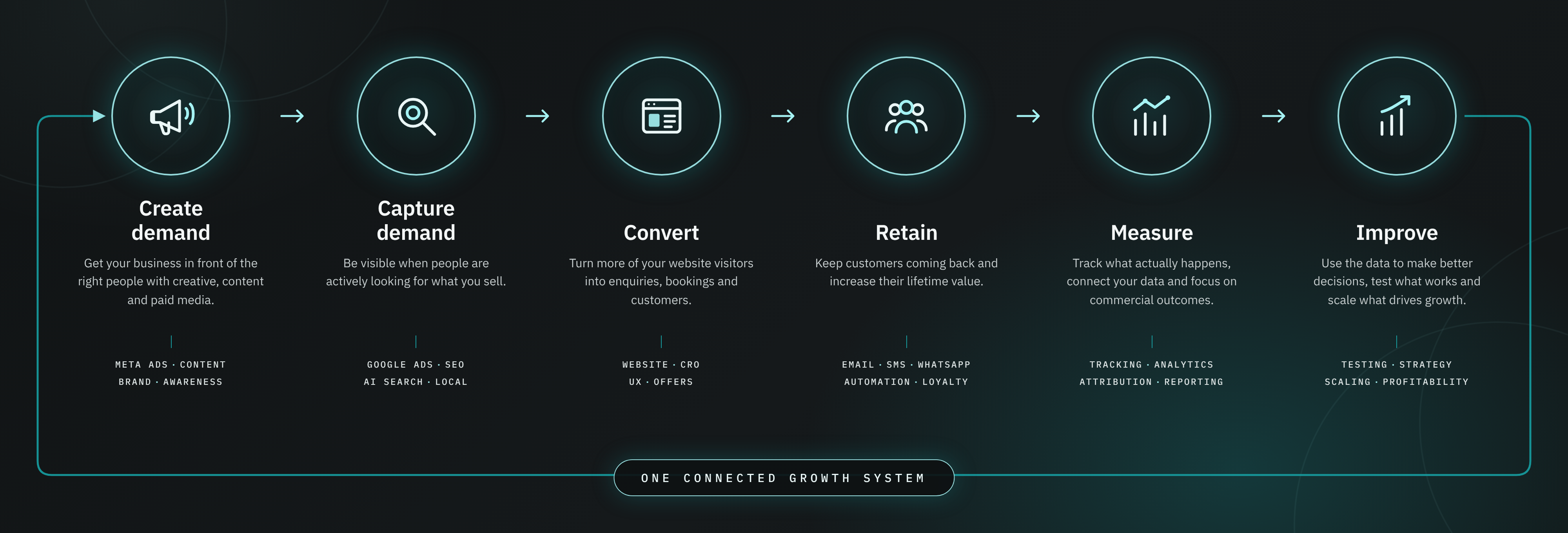
Each stage supports the next.
If you optimise only one stage, you can easily move the problem somewhere else.
Generate twice as much traffic to a poor website and you may simply waste twice as much money.
Generate hundreds of customers but never communicate with them again and you leave lifetime value on the table.
Build brilliant campaigns without accurate tracking and you may stop campaigns that are working while scaling ones that aren’t.
The whole system matters.
Which digital marketing channels should your business actually use?
There is no universal marketing mix that every business should follow.
The right channels depend on how people discover, evaluate and buy what you sell.
If people are actively searching for your product or service, Google Ads and SEO may deserve priority because demand already exists.
If the product is highly visual, emotional or something people often discover rather than search for, Meta advertising and strong creative may be more important.
If plenty of relevant people already visit your website but too few buy or enquire, conversion rate optimisation may create more value than buying additional traffic.
If your business has a large historic customer database, email, SMS, WhatsApp and customer automation may be the fastest route to additional revenue.
If your advertising platforms, analytics and sales records all tell you different things, tracking and measurement should probably come before increasing spend.
And if you’re already doing all of those things, your biggest problem may no longer be a marketing channel.
It may be coordination.
At that point the question becomes:
Where is the constraint?
And:
What should we fix first?
Is digital marketing better than traditional marketing?
Not automatically.
TV, radio, outdoor advertising, print, direct mail, events and sponsorship can all produce excellent results in the right circumstances.
The biggest difference is often the quality and speed of the feedback.
With digital marketing, businesses can often see which advertising people interacted with, what they searched for, which pages they visited, where they left the journey, whether they eventually purchased and what that customer was worth.
That creates a much faster learning cycle.
Traditional advertising can also generate significant demand that is difficult to attribute neatly to one source.
Increasingly, good marketing isn’t really about choosing between digital and traditional.
It is about understanding how everything you do contributes to the commercial outcome.
Why does digital marketing fail?
If digital marketing offers all of these advantages, why do businesses still waste so much money doing it?
Usually because having the tools isn’t the same as having a system.
Poor tracking
If your tracking counts a lead as a customer, records the same conversion twice or significantly disagrees with the system where the actual sale happened, everything built on those numbers becomes less reliable.
Bad measurement creates bad decisions.
Disconnected channels
One agency runs PPC.
Someone else manages the website.
Another company handles SEO.
The internal team sends email.
Somebody produces social content.
Nobody owns the overall customer journey.
Each individual part can appear busy while the whole system underperforms.
Sending more traffic into a website that doesn’t convert
Traffic is not revenue.
If visitors struggle to understand the offer, trust the business, find the information they need or complete the next step, buying more traffic simply amplifies the existing problem.
Measuring marketing activity instead of business outcomes
Clicks can be useful.
Click-through rate can be useful.
Reach can be useful.
Engagement can be useful.
But businesses ultimately survive on things such as customers, revenue, margin, bookings, subscriptions, enquiries and lifetime value.
Marketing metrics should help explain those outcomes.
They shouldn’t replace them.
Ignoring existing customers
Businesses can spend thousands acquiring customers and then barely speak to them again.
That means continually paying to replace demand that better retention could have preserved.
Trying to improve everything at once
Most established businesses can find 20 or 30 things in their marketing that could be improved.
That doesn’t mean they should fix all 30.
The more valuable question is:
Which change is most likely to improve the commercial result now?
What does connected digital marketing look like in practice?
Theory is useful.
Real businesses are better.
Here are three examples of what changes when digital marketing is treated as a connected commercial system rather than a collection of channels.
GOALS: capturing genuinely new demand
GOALS already had significant brand demand.
A large percentage of its Google Ads revenue came from people searching specifically for GOALS.
That can make advertising performance look excellent without necessarily showing that the advertising is generating incremental customers.
The strategy moved greater emphasis towards non-brand searches around products such as five-a-side football, parties and events.
Across the comparable periods, revenue attributed to non-brand paid search increased by 163% despite total Google Ads spend being 11% lower.
Email campaign revenue also increased 30.1%, while Meta activity supported specific commercial offers.
During the wider campaign period, GOALS recorded its first £1m week.
That £1m week was a business-wide result and we don’t claim that marketing alone caused it.
The useful lesson is what happens when paid search, paid social, email and commercial measurement work together.
See how GOALS increased non-brand search revenue by 163% →
Brownings the Bakers: joining acquisition and retention around the trading calendar
Brownings already had a strong local brand and physical retail presence.
The digital growth opportunity wasn’t simply “run more adverts”.
Paid social, content, seasonal campaigns, email, SMS and ecommerce activity were coordinated around the periods when customers were most likely to buy.
From March to December 2025, online revenue increased 43% year-on-year.
Online orders grew by 44%.
Paid media returned 13.9x its spend, at an average cost per acquisition of £3.02.
Brownings has its own reputation, stores and existing demand, so it would be misleading to claim every pound of that growth came from marketing.
What can be measured is the performance of the campaigns and how the individual pieces worked together.
See how Brownings returned 13.9x ad spend →
Six by Nico: measuring performance across multiple locations
Multi-location businesses introduce another problem.
One national marketing number can hide completely different results in individual locations.
Six by Nico operates multiple restaurants and launches a completely new six-course tasting menu every six weeks.
That means each launch has a fixed selling period and each location needs enough booking demand at the right time.
Campaigns are therefore structured around individual cities, menus and booking outcomes rather than one broad advertising number.
Across the evidenced comparison, cost per cover fell from £3.59 to £1.53.
That’s a 57% reduction.
The bigger lesson isn’t the percentage itself.
It’s the ability to see which location, offer and campaign needs attention and act on that information quickly.
See how Six by Nico reduced cost per cover by 57% →
Do you actually need more digital marketing?
Not necessarily.
That might sound unusual coming from a digital growth company.
But more marketing isn’t always the answer.
You may already receive enough traffic.
You may already spend enough on advertising.
You may already have thousands of customers.
You may already have a good website.
The problem could sit somewhere completely different.
Before adding another agency, another channel or another few thousand pounds of monthly spend, it is worth understanding what is actually limiting growth.
Can you trust your tracking?
Do you know which acquisition channels create genuinely new customers?
Does your website convert enough of the traffic you already have?
Are you making enough from existing customers?
Does your reporting actually lead to better decisions?
If the answer to several of those questions is “we’re not really sure”, your next marketing investment probably shouldn’t be another campaign.
It should be finding out.
Start with the constraint
This is why we created the Growth Audit.
Instead of beginning with:
“Which of our services can we sell you?”
we begin with:
“Which part of your growth system is actually holding you back?”
The Growth Audit looks across the five areas that determine whether marketing turns into customers: tracking and data quality, acquisition, website and conversion, retention and CRM, and reporting and decision-making.
You receive a Growth Readiness Score, the evidence behind the findings, a performance snapshot and your five highest-priority growth opportunities.
We also tell you the one thing we would focus on first if it were our business.
The audit costs £195.
Your results call takes place within 14 days of onboarding, assuming we have the access required to complete the work.
If you choose to continue into a Growth Sprint, the £195 is credited against it.
If you decide to do nothing afterwards, you keep the report.
There is no obligation to work with us.
And if, at the end of your results call, you don’t believe the audit was worth every penny, say so and we’ll refund the £195.
Frequently asked questions about digital marketing
Why is digital marketing important for small businesses?
Digital marketing gives smaller businesses access to customers without needing the scale required for many traditional advertising channels.
Search marketing can capture local or high-intent demand. Social advertising can introduce the business to specific audiences. Email and messaging can help generate more value from previous customers.
The important part isn’t trying to use every digital channel.
It’s identifying where your customers actually spend time and how they make a buying decision.
What are the main benefits of digital marketing?
The main benefits include greater measurability, more precise targeting, the ability to capture existing demand, the ability to create new demand, faster experimentation, improved website conversion and better customer retention.
Its biggest advantage is that those activities can be connected into one measurable customer journey.
What is the most effective type of digital marketing?
There is no single most effective digital marketing channel.
Google Ads can be extremely valuable when customers are actively searching for what you sell.
Meta advertising can work particularly well when a product needs to be discovered or demonstrated visually.
SEO can build visibility that compounds over time.
Email, SMS and WhatsApp can be extremely efficient for businesses with an established customer base.
The best channel depends on how your customers buy and where the current constraint exists in your business.
Is digital marketing better than traditional marketing?
Not necessarily.
Traditional channels such as TV, radio, outdoor, print, events and sponsorship can still be highly effective.
Digital marketing’s biggest advantage is normally the speed and depth of feedback available.
Businesses can often observe customer behaviour, test changes and connect activity to commercial outcomes more easily.
For many established businesses, the best approach isn’t digital or traditional. It is understanding how the channels work together.
How much should a business spend on digital marketing?
There is no sensible universal percentage.
The right budget depends on things such as customer value, gross margin, acquisition cost, available market demand, conversion rates and the economics of the business.
If acquiring a customer for £100 reliably generates significantly more than £100 of contribution over that customer’s lifetime, increasing spend may make sense.
If the economics don’t work at £100, simply spending more money will not solve the underlying problem.
How long does digital marketing take to work?
It depends on the channel and the problem being solved.
Paid advertising can start generating data quickly, although meaningful optimisation normally requires more time.
Website conversion changes can sometimes show an impact quickly where traffic volumes are high.
SEO typically takes longer because visibility has to be built and earned over time.
Retention campaigns can generate results quickly if the business already has a large customer database.
The more useful question is often not “how long does digital marketing take?” but “how long should this particular intervention take before we know whether it is working?”
Do I need SEO, Google Ads or social media?
Possibly.
But you may not need all three.
If customers already search heavily for what you provide, Google Ads and SEO may deserve priority.
If people need to discover the product before they would ever search for it, paid social may be more important.
If you already generate substantial traffic and demand, neither may be your biggest opportunity.
The decision should come from customer behaviour and business economics rather than whichever service a supplier happens to sell.
Can digital marketing help an established business?
Yes.
And the opportunity can be very different from that of a start-up.
Established businesses may already have substantial traffic, brand awareness, customer data, advertising budgets and multiple marketing channels.
The challenge is often getting those existing assets working together more effectively, improving measurement and identifying which part of the customer journey is limiting further growth.
The bottom line
So, why is digital marketing important for business?
Because it gives businesses more than another way to advertise.
It creates a system for generating demand, capturing intent, converting customers, retaining them, measuring what happens and learning what to improve next.
But having more marketing channels does not automatically produce better marketing.
The businesses that benefit most stop thinking about Google Ads, Meta, SEO, websites, email and analytics as unrelated activities.
They start thinking about the journey:
- Attention
- Demand
- Customer
- Repeat customer
- Data
- Better decision
Then they identify the weakest part.
And improve that first.